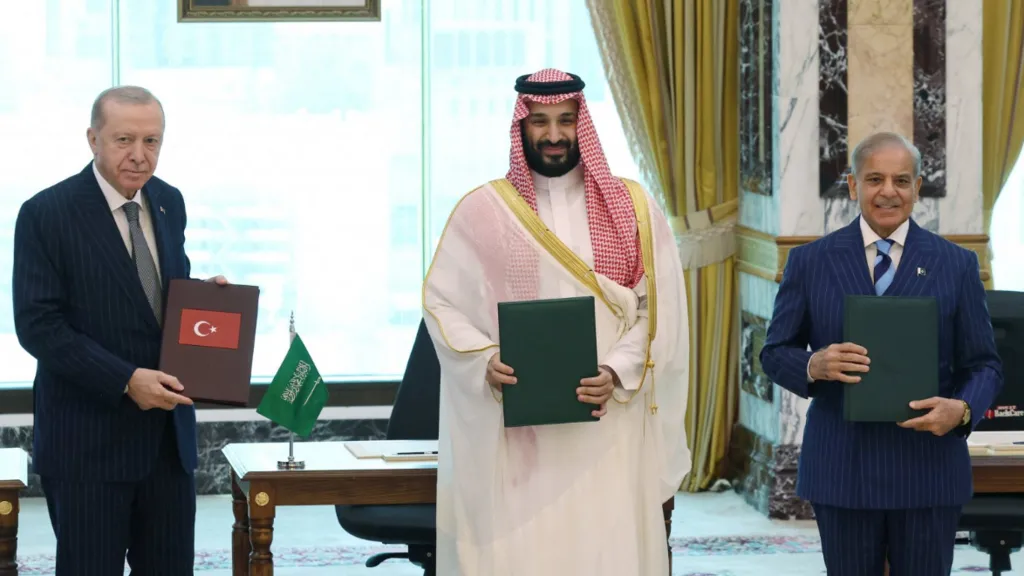
Three Countries Strengthen Military Cooperation
The agreement was signed in Mecca on August 7, 2026, bringing Saudi Arabia, Turkey and Pakistan into a new framework for defence cooperation. The pact builds on the existing strategic relationship between Pakistan and Saudi Arabia while adding Turkey's considerable military capabilities and defence industry.
The three countries have emphasized that the agreement is intended to strengthen collective security and deterrence rather than target a specific country.
"Attack on One Is an Attack on All"
The most important element of the agreement is its mutual-defence provision.
Under the pact, an armed attack against one of the three signatories will be treated as an attack against all three. This resembles the basic principle behind NATO's collective-defence arrangements, although analysts caution that the agreement does not necessarily create an organization identical to NATO.
The provision could significantly change calculations for any country considering military action against one of the signatories.
Why Pakistan Is Important
Pakistan brings substantial military capabilities to the partnership, including one of the region's largest conventional forces and a nuclear deterrent.
Islamabad also has decades of defence cooperation with Saudi Arabia. Pakistani military personnel have previously provided training and other security assistance in Saudi Arabia, giving the relationship an established operational foundation.
The new trilateral arrangement could therefore expand cooperation in areas such as military training, intelligence, defence technology and joint exercises.
Turkey Adds Military and Industrial Strength
Turkey has developed a powerful domestic defence industry in recent years, particularly in drones, missiles, naval systems and other military technologies.
Ankara's participation gives the new partnership another major military-industrial capability and could create opportunities for greater defence production and technology cooperation among the three countries.
Saudi Arabia Brings Financial and Strategic Influence
Saudi Arabia is one of the Middle East's most influential economic and political powers and has been investing heavily in modernizing its armed forces.
Riyadh has also been reassessing its traditional dependence on Western security guarantees. The new agreement reflects Saudi Arabia's broader effort to diversify its international partnerships and strengthen regional security arrangements.
Regional Tensions Provide Important Background
The agreement comes at a time of significant instability across the Middle East and surrounding regions.
The three countries face different security concerns. Pakistan remains focused heavily on South Asian security, Turkey has interests and security challenges involving Syria, Iraq and Greece, while Saudi Arabia has faced threats from Iran-linked groups and instability elsewhere in the Gulf region.
The pact therefore brings together countries with different strategic priorities but a shared interest in strengthening regional security.
Iran Responds
Iran has said there is no reason to be concerned about the new Pakistan-Turkey-Saudi security pact.
Iranian Foreign Ministry spokesman Esmaeil Baghaei said on August 10 that Tehran views regional security cooperation as potentially positive if it is inclusive and based on the region's realities.
His comments suggest that Tehran is closely watching the new alliance but is seeking to avoid an immediate escalation in rhetoric.
Could the Pact Expand?
There has already been discussion of broader regional security cooperation involving countries such as Egypt and Qatar.
Analysts say the new arrangement could eventually develop into a wider regional security framework, although differences among potential members could make expansion complicated.
For now, the three-country agreement is the clearest step toward a more coordinated security partnership.
Impact on Regional Geopolitics
The agreement could have several long-term consequences.
It may encourage:
- Greater military exercises among the three countries
- Intelligence and security cooperation
- Defence-industrial partnerships
- Increased arms and technology transfers
- Stronger deterrence against external threats
- Reduced dependence on Western security guarantees
At the same time, the pact could force neighboring countries to reassess their own defence and diplomatic strategies.
A New Security Era?
The agreement represents an important shift in the strategic landscape of the Middle East and South Asia.
Rather than relying exclusively on major external powers, Saudi Arabia, Turkey and Pakistan are attempting to strengthen their own regional security capabilities. Whether the pact develops into a fully integrated military alliance will depend on how the countries implement its commitments in practice.
Conclusion
The new Saudi Arabia-Turkey-Pakistan defence pact represents a significant development in regional security. Its central principle—that an attack on one member will be regarded as an attack on all three—creates a stronger deterrent and deepens military ties among the partners.
The agreement does not immediately create a NATO-style organization, but it signals a growing move toward regional security cooperation and strategic self-reliance. Its long-term impact will depend on how far the three countries are prepared to translate the agreement into joint military planning, intelligence cooperation and defence integration.